Kochi University of Technology
Achieving End-to-End Optimization by Connecting Partially Optimized Systems
University preserves existing investments while creating unified data platform
Key Results
- 20+ systems integrated: Providing data to over 20 systems and file output destinations
- In-house data integration realized: Expanded the scope of data utilization
- Improved work efficiency: Prevents data omissions and input errors
- Educational IR foundation established: Infrastructure for activating Institutional Research
University Overview
Established in 1997 as a publicly funded, privately operated university, Kochi Prefectural Public University Corporation, Kochi University of Technology (referred to as "Kochi University of Technology" in this case study) is now a public university that actively introduces advanced educational systems. Guided by its motto, “a university where students can grow,” the university operates five academic colleges across sciences and liberal arts, including the newly established school of Data & Innovation in 2024. It promotes data-driven educational reform with a strong focus on advancing digital transformation.
Summary
Kochi University of Technology faced challenges with decentralized educational data—such as entrance examination results, academic performance, and employment information, which were managed independently by each department and only accessible to a limited number of users. To address this, the university implemented DataSpider Servista (the brand name of HULFT Integrate in Japan) to consolidate and manage data through an integrated database. This successfully enabled in-house data integration and established a foundation for activating educational IR.
Challenge
Multiple systems managed independently across departments, the university lacked centralized control and real-time data visibility. This fragmented structure became a bottleneck for institutional research (IR), cloud migration, and interdepartmental collaboration.
“One of the issues we faced was that data related to students, such as entrance examination results and employment information, had been managed by each department, and only a limited number of members were able to utilize the data,” recalls Mr. Shinichi Yoshida, Director, Computing Support Center ; Professor, School of Informatics and School of Data and Innovation.
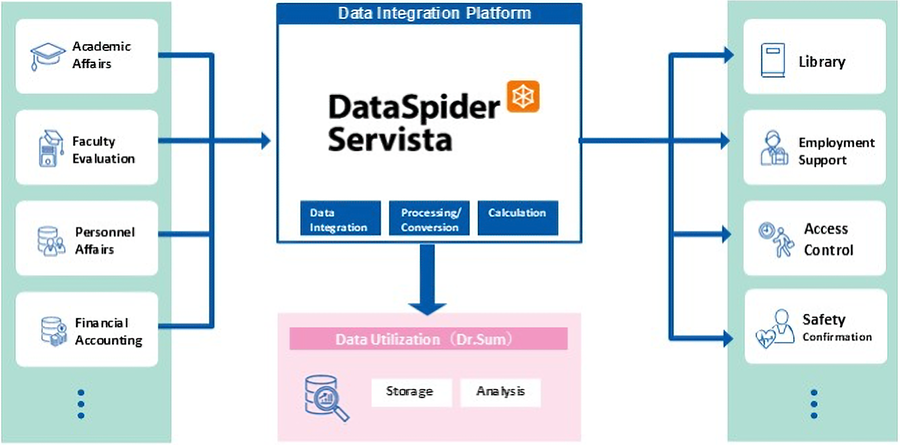
Although an educational system existed to consolidate academic data, it lacked integration with key management data like finance and HR. Therefore, the university adopted a realistic approach: to link partially optimized systems across departments for overall optimization.
Results
The university has now established an internal data integration platform, linking diverse systems such as academic affairs, faculty evaluation, employment support, and access control. DataSpider Servista currently feeds data to over 20 systems and file outputs, including cloud-based services like safety confirmation tools.
Integration is bi-directional: for instance, academic affairs data is returned to input systems in real time via APIs or file-based transfers. “The ability to manage this in-house gives us speed and flexibility we didn’t have before,” says Mr. Mori. “If we had outsourced this, we would have been limited by time and budget.”
The university also reported greater data utilization and higher operational efficiency. Tasks once handled separately, such as student data entry, are now streamlined and consistent, which helps reduce input errors and omissions.
Solution
One critical requirement was the ability to develop and operate the integration platform in-house. “There was a need for a user-friendly platform that could be managed internally, even by non-developers,” says Mr. Akihiko Mori, Manager Section Chief, IT and Services Section.
They evaluated platforms based on compatibility with various databases (Oracle, PostgreSQL), complex data conversions, and the ability to calculate metrics for systems such as faculty evaluation. DataSpider Servista was chosen through a bidding process because it met these criteria.
“We also highly evaluated the fact that DataSpider Servista can perform processing in a local environment and its superior calculation functions compared to other products,” says Mr. Eiji Fukutomi, Assistant Chief. The team appreciated the GUI-based development environment, which even those without Java knowledge could manage, while staff with Java expertise found the system’s error displays intuitive.
Today, the university uses DataSpider Servista as its internal data distribution infrastructure. It supports integration with systems such as academic management, faculty evaluation, access control, and employment support, and enables feedback to input systems like academic affairs. Connection methods are flexibly selected based on the destination such as API, ODBC, FTP, or file transfer.
Operational stability is ensured through regular monitoring and visual inspection of processing logs. “It’s operating smoothly with no major issues,” says Mr. Fukutomi.
The team also values the platform’s scalability and licensing model. “Since there’s no additional cost per script or project, we can test and adapt as needed, such as by changing output formats or adding email notifications,” adds Mr. Mori.
Future Plan
While individual staff members traditionally handled Institutional Research (IR), the infrastructure for more systematic IR is now in place. “We believe it’s necessary to shift to objective, data-based decision-making,” says Mr. Fukutomi.
The university is now working to connect entrance exam, academic, and employment data to support student learning and provide insights for prospective students, helping reduce mismatches between students and institutions.
In addition, the newly founded School of Data & Innovation will play a key role in regional data collaboration.
“There’s significant potential to expand this as a common platform across the entire Kochi Prefectural University Corporation,” Mr. Fukutomi notes.
They are also exploring iPaaS options such as HULFT Square and metadata tools like HULFT DataCatalog to support future cloud migration. “As a stepping stone for broader digital transformation, we’ll continue to use DataSpider Servista to drive digital transformation in education,” concludes Mr. Mori.
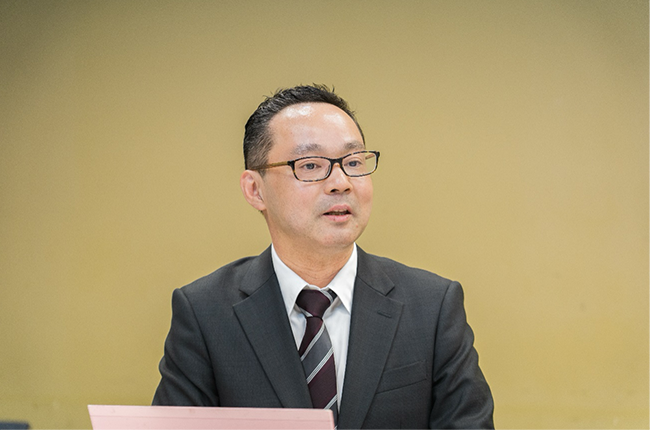 Mr. Shinichi Yoshida, Director, Computing Support Center/Professor, Dr. Eng.,
 Intelligent Informatics Laboratory, School of Informatics, School of Data & Innovation.
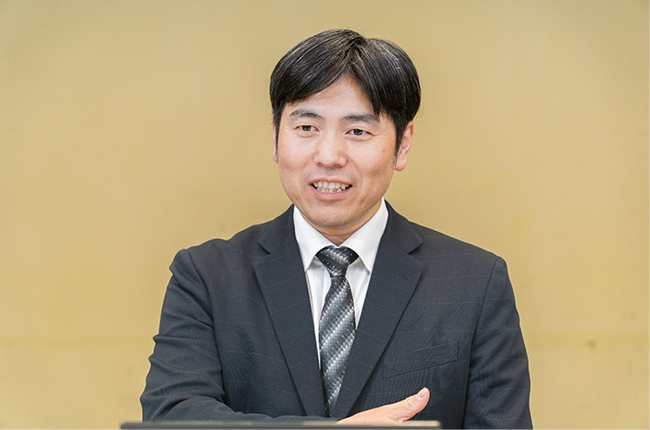 Mr. Akihiko Mori, Section Chief, Information Technology and Service Section, General Affairs Division, Kochi University of Technology
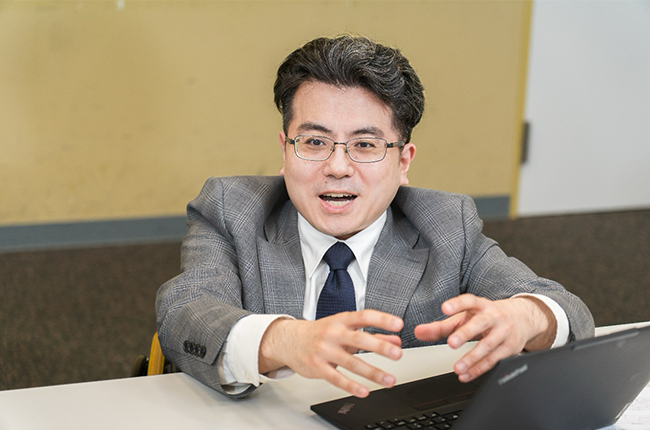 Mr. Eiji Fukutomi, Assistant Chief, Information Technology and Service Section, General Affairs Department, Kochi University of Technology